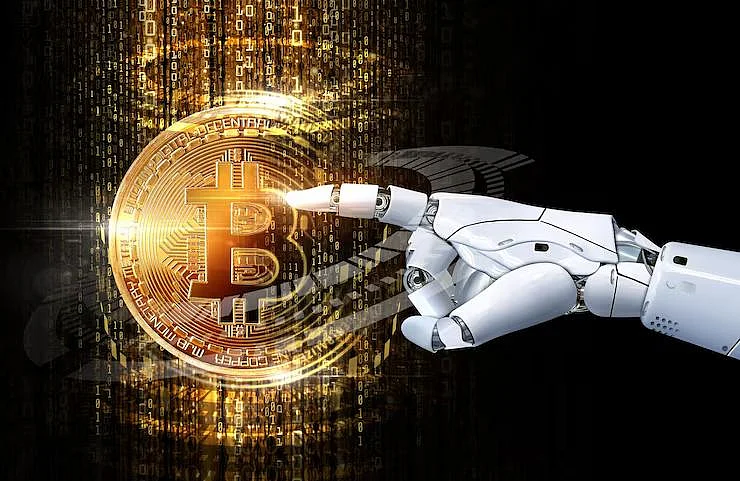
Crypto already moves fast. Add AI to the mix—and things don’t just get faster, they get smarter.
But here’s the catch: smarter doesn’t always mean safer.
Related reading: If you want more context, also read how to build a crypto portfolio and how to rebalance a crypto portfolio.
Let’s break down how AI and crypto are merging, what’s real today, and what actually changes for investors.
The Shift: From Manual Trading to Machine Decisions
Traditional crypto investing is:
- Chart analysis
- News tracking
- Manual buy/sell decisions
AI flips this.
Now you have:
- Models scanning thousands of data points
- Bots executing trades in milliseconds
- Systems adapting to market patterns
According to research from firms like McKinsey and BIS, AI-driven trading is already common in traditional finance—and crypto is catching up quickly.
1. AI-Powered Trading (Already Happening)
AI trading tools use:
- Machine learning models
- Historical price data
- Sentiment analysis (Twitter, Reddit, news)
Example: A bot detects:
- Increased social buzz
- Volume spikes
- Price momentum
→ Executes a trade before most humans react.
Reality check: These systems don’t guarantee profits. Markets are noisy, and models can fail.
2. Smarter Portfolio Management
AI isn’t just for trading—it’s for allocation.
Instead of guessing how much to invest in BTC vs altcoins, AI can:
- Rebalance portfolios automatically
- Adjust risk exposure
- Identify correlations between assets
Mini Example:
- Market volatility rises
→ AI reduces exposure to high-risk tokens
→ Increases stablecoin or BTC allocation
This is similar to robo-advisors in traditional finance—but adapted to crypto.
3. On-Chain Data + AI = Better Insights
Crypto is transparent. Every transaction is public.
AI makes sense of it.
Platforms now analyze:
- Wallet movements
- Whale activity
- Exchange inflows/outflows
Example insight: Large BTC inflows to exchanges → potential sell pressure.
Without AI, this data is overwhelming. With AI, it becomes actionable.
4. DeFi Automation (Where It Gets Interesting)
AI + DeFi creates:
- Auto-yield optimization
- Smart liquidity allocation
- Dynamic staking strategies
Instead of manually chasing yields, AI can:
- Move funds between protocols
- Optimize returns based on risk
But: Smart contracts + AI = double risk layer (code + model).
The “AI Crypto Investing Stack†(Framework)
Think of this as layers:
- Data Layer – on-chain + market data
- AI Layer – prediction models, pattern recognition
- Execution Layer – bots, smart contracts
- Risk Layer – stop-loss, diversification rules
If one layer fails, the whole system can break.
Benefits vs Risks (Quick Comparison)
| Area | Advantage | Risk |
|---|---|---|
| Trading | Faster decisions | Overfitting models |
| Portfolio | Automated balance | Wrong assumptions |
| Data | Deep insights | Misinterpreted signals |
| DeFi | Passive optimization | Smart contract risk |
Where Experts Disagree
Optimists (e.g., tech firms, venture funds):
- AI will democratize investing
- Retail investors gain institutional-level tools
Skeptics (e.g., BIS, some academics):
- AI may amplify volatility
- Herd behavior from similar models
Balanced view: AI improves tools—but doesn’t remove market risk. In fact, it may concentrate it.
Common Mistakes Investors Will Make
- Blindly trusting AI signals
- Using bots without understanding strategy
- Ignoring risk management
- Chasing “AI coins†without fundamentals
Expert Tips (Use These)
1. Treat AI as an assistant, not authority
Use it to inform decisions—not replace judgment.
2. Start small with automation
Test bots with limited capital before scaling.
3. Focus on data quality
Bad data → bad AI decisions.
Quick-Start Checklist
- Choose a reliable AI trading or analytics tool
- Define risk limits (max loss, allocation %)
- Monitor performance weekly
- Avoid full automation at the start
FAQ
1. Can AI predict crypto prices accurately?
Not consistently. It can improve probability, but markets remain unpredictable.
2. Are AI trading bots profitable?
Some are—but performance varies widely and depends on strategy and market conditions.
3. What is AI’s biggest advantage in crypto?
Speed and ability to process massive datasets.
4. Is AI + DeFi safe?
It adds convenience but also increases technical and security risks.
5. Will AI replace human investors?
Unlikely. It will augment decision-making, not fully replace it.
Conclusion (Next Step)
AI + crypto isn’t a magic formula—it’s a shift in how decisions get made.
The edge won’t come from using AI.
It’ll come from how well you understand and control it.
Start small, stay skeptical, and treat AI as leverage—not a shortcut.