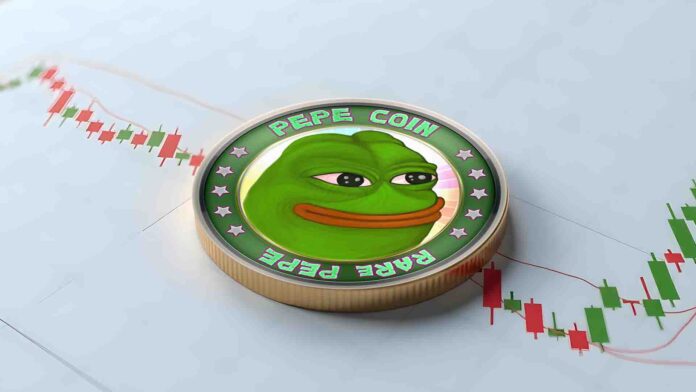
Pepe Coin has gone from a joke token to a serious market mover in record time. That alone makes people ask the obvious question: did I miss the opportunity, or is there still upside left?
Here is the thing. Meme coins do not follow traditional valuation logic. But they are not completely random either. If you look at liquidity flows, social momentum, tokenomics, and market cycles, you can actually build a grounded view.
Related reading: If you want more context, also read what tokenomics means and market cap matters more than coin price.
This breakdown strips out hype and focuses on what matters for an investor trying to decide whether Pepe Coin still makes sense.
Technology & Use Case
Pepe Coin does not pretend to be a groundbreaking blockchain project, and that is important to understand upfront.
It is built as an ERC-20 token on Ethereum. That means:
- It inherits Ethereum's security and infrastructure
- It can integrate with DeFi tools, wallets, and exchanges easily
- It does not need its own blockchain or consensus mechanism
But here is the reality: Pepe's value is not driven by technology. It is driven by attention.
Unlike utility tokens used in DeFi, gaming, or AI, Pepe operates on:
- Meme culture
- Viral momentum
- Community-driven speculation
That does not make it worthless. It just means its value behaves differently. In crypto, attention is often more powerful than utility, at least in short cycles.
Historical Performance
Pepe Coin launched in 2023 and immediately exploded.
Within weeks:
- It achieved a multi-billion dollar market cap
- Early buyers saw massive returns, some in the 100x to 1000x range
- It became one of the fastest-growing meme coins ever
But like every meme coin:
- It saw sharp corrections after the initial surge
- Price movements became highly volatile
- Gains started depending more on timing than fundamentals
What this really means is:
- Early phase equals explosive growth
- Mid phase equals consolidation plus speculation
- Late phase depends on new hype cycles
Right now, Pepe sits somewhere between mid and late cycle behavior.
Tokenomics & Supply
Tokenomics is where Pepe becomes interesting and risky.
Key characteristics:
- Massive total supply in the hundreds of trillions
- No intrinsic scarcity like Bitcoin
- Heavy reliance on demand to drive price
Why this matters:
- Even small price increases require large inflows of capital
- Price jumps often come from hype waves, not structural demand
- Whale activity can influence price significantly
However, Pepe benefits from:
- High liquidity on major exchanges
- Strong retail participation
- Meme-driven holding behavior, where people hold for fun, not logic
In simple terms, price movement depends more on psychology than economics.
Adoption & Ecosystem
Pepe's adoption is not about real-world use. It is about visibility.
Where it wins:
- Listed on major centralized exchanges
- Strong presence on crypto Twitter and Reddit
- Recognizable meme identity
Where it lacks:
- No major ecosystem such as apps, games, or DeFi protocols
- No strong developer roadmap
- No real utility expansion
But here is the twist: meme coins do not need traditional adoption.
They thrive on:
- Social momentum
- Cultural relevance
- Viral cycles
If Pepe stays culturally relevant, it stays alive.
Risks & Challenges
Let us be clear. Pepe is a high-risk asset.
Key risks:
1. No Intrinsic Value
If hype disappears, there is nothing fundamentally supporting price.
2. Whale Dominance
Large holders can cause sudden dumps.
3. Market Cycle Dependency
Pepe performs best in bull markets. In bear markets, meme coins get hit hardest.
4. Competition
New meme coins constantly emerge, stealing attention.
5. Liquidity Traps
Late buyers often enter near peaks during hype spikes.
Bottom line: Pepe is momentum-driven, not value-driven.
Pepe Coin Price Prediction (2026-2030)
Let us break this down realistically, not with hype predictions.
2026 Prediction
By 2026, Pepe's performance will heavily depend on whether the current crypto cycle extends or resets.
Expected range:
- Conservative: sideways or slight growth
- Bull case: new all-time highs if meme cycle returns
Reasoning:
- If Bitcoin leads a strong bull market, meme coins typically follow
- Pepe could benefit from renewed retail interest
2027 Prediction
2027 could be a correction or stabilization phase.
Expected range:
- Moderate decline or consolidation
Reasoning:
- Post-bull cycles often bring cooling periods
- Meme coins usually lose momentum faster than utility projects
2028 Prediction
This year aligns with another potential crypto cycle shift.
Expected range:
- Early-stage recovery
Reasoning:
- New narratives start forming
- Meme coins may regain attention if retail returns
2029 Prediction
Potential peak cycle year.
Expected range:
- Strong upside potential
Reasoning:
- If a full bull run develops, Pepe could ride momentum again
- Price increases will depend on social traction, not fundamentals
2030 Prediction
Long-term sustainability test.
Expected range:
- Highly uncertain
Reasoning:
- Only meme coins with lasting cultural relevance survive
- Pepe needs continuous community strength to remain relevant
What Experts Say
Most analysts fall into three camps:
1. Skeptics
They argue Pepe has no real value and will fade over time.
2. Traders
They see Pepe as a short-term opportunity based on momentum.
3. Cycle Analysts
They believe Pepe can spike again, but only during bull markets.
The consensus is surprisingly consistent:
- Short-term gains are possible
- Long-term sustainability is uncertain
AI Price Prediction (Trend-Based Analysis)
If you model Pepe using trend-based AI frameworks instead of hype, a few patterns emerge:
- Price correlates strongly with Bitcoin dominance cycles
- Social sentiment spikes often precede price surges
- Volume expansion is the strongest predictor of growth
AI-based projection suggests:
- High volatility remains constant
- Growth happens in short bursts, not steady trends
- Long flat periods are normal
In simple terms: Pepe does not trend. It spikes.
Realistic vs Hype Scenario
Let us separate fantasy from reality.
Realistic Scenario
- Moderate growth during bull cycles
- Sharp corrections after hype
- Long periods of sideways movement
Hype Scenario
- Massive price surge fueled by viral trends
- Retail FOMO drives exponential growth
- Short-lived peaks followed by crashes
Most investors lose money in the hype scenario because they enter late.
Worst-Case Crash Price
This is where most articles avoid honesty.
Worst-case scenario:
- Loss of social relevance
- Market-wide crypto crash
- Whale exits
Possible outcome:
- 70% to 90% decline from peak levels
This has already happened to multiple meme coins in past cycles.
If demand disappears, Pepe can drop fast because there is no safety net.
Is It Too Late to Buy Pepe Coin?
This is the real question.
Here is the honest answer:
- Too late for early-stage gains? Yes.
- Too late for cycle-based profits? Not necessarily.
What this really means:
- You are not getting 100x returns anymore
- But smaller gains during hype cycles are still possible
The key difference now is strategy:
- Early buyers depended on luck and timing
- Current buyers depend on timing and discipline
How to Approach Pepe as an Investor
If you are considering buying, think like this:
- Treat it as a speculative asset, not a long-term investment
- Allocate only a small portion of your portfolio
- Focus on entry timing, not blind holding
- Watch market sentiment closely
Pepe rewards timing, not belief.
Conclusion: Pepe Coin Price Prediction and Final Verdict
Pepe Coin sits in a unique position. It is not dead, but it is no longer early.
The Pepe Coin price prediction depends less on technology and more on market psychology. If crypto enters another strong bull phase, Pepe can absolutely surge again. But those gains will likely come in bursts, not steady growth.
What matters now is how you play it.
- If you are chasing hype, you are late
- If you are trading cycles, there is still opportunity
- If you are looking for fundamentals, this is not the right asset
The smart move? Treat Pepe like what it is: a high-risk, high-volatility meme asset, and approach it with strategy, not emotion.